

Aluzinc has become one of the most important raw materials in Peru’s roofing and construction industry. Known globally as Galvalume, this advanced steel product is widely used in roofing projects due to its exceptional durability, corrosion resistance, and long-term performance. As Peru’s construction sector continues to expand, Aluzinc steel coils are now considered a foundational material for both industrial and commercial building applications.
Aluzinc is produced by coating cold‑rolled steel with a specialized alloy consisting of approximately 55% aluminum, 43.4% zinc, and 1.6% silicon. This unique composition gives the material outstanding thermal reflectivity and structural longevity. Compared to traditional galvanized steel, Aluzinc can last four to six times longer, making it a preferred choice for developers seeking long-term value.
Why Aluzinc Is a Critical Raw Material in Peru’s Roofing Industry
Peru’s steel coil import market exceeds USD 430 million annually, and a significant portion of this demand comes from Aluzinc. The country’s diverse climate zones create harsh conditions for metal structures. Coastal regions like Lima face constant humidity and salt exposure, while the Andean highlands experience aggressive temperature shifts and intense UV radiation. Aluzinc’s resilience makes it ideal for these environments, ensuring roofs and metal structures maintain their integrity over time.
How Local Manufacturers Use Aluzinc in Roofing Production
Local metal‑mechanic shops and industrial manufacturers rely heavily on Aluzinc coils to fabricate custom roofing sheets, structural panels, and other metal components. Large-scale commercial projects—shopping centers, warehouses, factories, and logistics hubs—depend on Aluzinc for its strength and long-term reliability.
While natural Aluzinc remains a steady seller, prepainted Aluzinc coils are rapidly gaining market share in Peru. These coils offer enhanced aesthetics and additional protection, making them popular for modern architectural designs.
Common Coil Dimensions Used in Peru
Common specifications distributed throughout Lima and regional hubs include thicknesses between 0.30 mm and 0.50 mm, with a standard width of 1220 mm.
For developers aiming to extend building lifecycles and reduce cooling costs, investing in high-quality Aluzinc coils is no longer optional—it has become the modern benchmark for construction in Peru. With its proven performance and growing market demand, Aluzinc continues to shape the future of the country’s industrial and commercial infrastructure.
What is Aluzinc and what are the Advantages
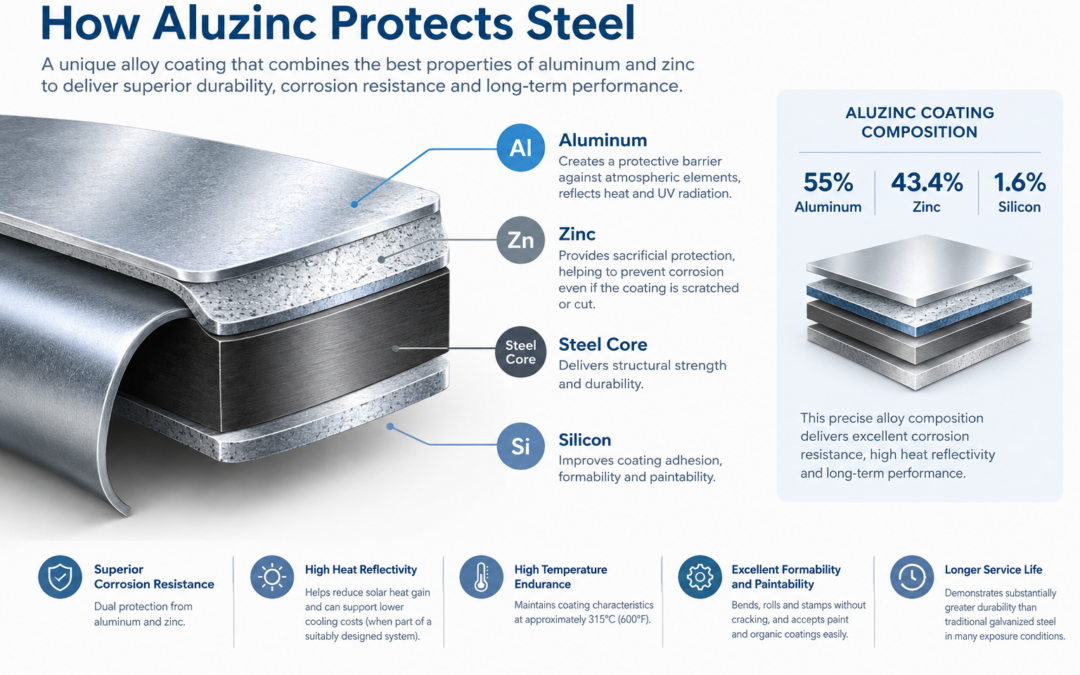
Aluzinc is a premium coated steel product that has transformed the construction and manufacturing industries. Often recognized by trade names like Galvalume or Zincalume, this material is engineered by coating carbon steel with an alloy comprising 55% aluminum, 43.4% zinc, and 1.6% silicon. This combination blends the barrier protection of aluminum with the sacrificial protection of zinc. The result is a highly durable metal that offers exceptional performance in harsh environments.
fig . 1 – composition of aluzinc
The unique composition of Aluzinc provides several distinct advantages over traditional galvanized steel:
- Superior Corrosion Resistance: The aluminum in the coating forms an inert physical barrier against atmospheric elements. Meanwhile, the zinc provides galvanic protection, healing minor scratches and cut edges. This dual-action defense makes Aluzinc up to four times more corrosion-resistant than standard galvanized steel, significantly extending its operational lifespan.
- Outstanding Heat Reflectivity: Aluzinc possesses a bright, silvery surface that reflects a high percentage of solar radiation and thermal heat. This property makes it an ideal choice for roofing and cladding in warm climates, as it helps maintain cooler indoor temperatures and lowers energy costs associated with air conditioning.
- High Temperature Endurance: Unlike galvanized coatings that degrade under intense heat, Aluzinc can withstand continuous exposure to temperatures up to 315°C (600°F) without discoloring or scaling. This makes it highly effective for industrial applications, including heat exchangers, exhaust systems, and oven components.
- Excellent Formability and Paintability: The addition of silicon to the alloy enhances the coating’s adhesion to the steel core. This allows the material to be bent, rolled, or stamped into complex shapes without the coating cracking or peeling. Furthermore, its surface provides an excellent bond for paints and organic coatings, eliminating the need for complex chemical pretreatments.
- Cost-Effectiveness: Because of its enhanced durability, Aluzinc requires minimal maintenance over its life cycle. Its long service life translates to fewer replacements, offering building owners and manufacturers a substantial return on investment.
Aluzinc represents a perfect marriage of strength, longevity, and versatility. Whether utilized for architectural roofing, industrial machinery, or outdoor agricultural equipment, its ability to withstand the elements makes it a premier material choice for modern engineering challenges.
Aluzinc Coils vs. Galvanized Coils
| ALUZINC COILS | GALVANIZED COILS | |
| Corrosion Resistance | Lasts Longer (2 to 6 times) | Dos not last as long as Aluzinc Coils |
| Heat Resistance | Can resist up to 315 Degrees (Celsius) | Can resist up to 200 Degrees (Celsius) |
| Coating | Coated with 55% Aluminum, 43.4% Zinc | Coated in pure Zinc |
| Surface & Spangles | Aluzinc has a smoother, finer appearance | Galvanized coils has a visible spangle/pattern |
| Cut-Edge Protection | Raw edges may need sealants in aggressive environments | Better self-healing action on raw cut edges |
Conclusion
Aluzinc has established itself as a cornerstone of Peru’s construction and roofing industry. Its unmatched durability, superior corrosion resistance, and ability to withstand the country’s diverse environmental conditions make it the preferred choice for developers, manufacturers, and large‑scale commercial projects. As demand continues to rise—driven by both infrastructure expansion and the shift toward longer‑lasting building materials—Aluzinc steel coils are becoming the new standard for quality and performance in Peru.
With growing interest in prepainted Aluzinc, improved energy efficiency, and extended building lifecycles, the material’s importance will only increase in the years ahead. For any developer or manufacturer seeking reliability, cost savings, and long-term structural protection, investing in high‑grade Aluzinc is not just a smart decision—it is essential for staying competitive in Peru’s rapidly evolving construction landscape.
L.E.B Enterprises, Inc. is the author of this article. The company has over 40 years of experience in international business, including importing and exporting of raw materials for various industries. The company deal with over 30 countries and is an expert in international trade including logistics, sourcing and financing. You can find them at www.lebenterprises.com to view their list of products and to get in touch with them.